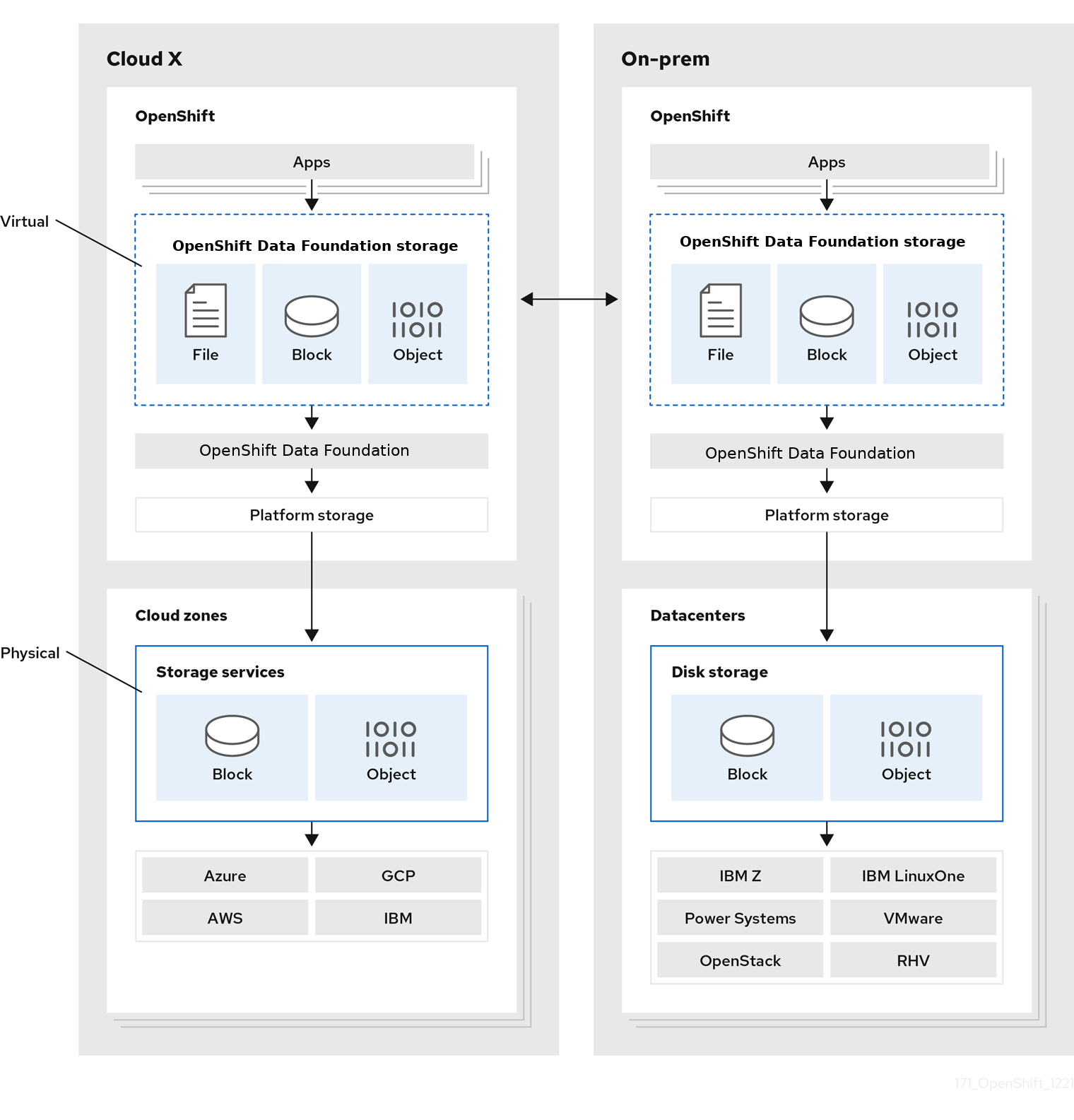
Software-defined storage inside OpenShift: block, file and object (Ceph) for the data that lives with the containers.
ODF brings Ceph inside OpenShift as native storage: block volumes for databases, shared file systems, S3 object storage — provisioned via StorageClass, replicated across nodes, managed like everything else on the platform. Data becomes a citizen of the cluster, not a guest of a SAN.


Ceph wants thought-out nodes and disks: replicas, failure domains and growth are sized beforehand.
With OpenShift Virtualization, ODF gives VMs live migration and snapshots: the piece that completes the VMware exit.
Snapshots, clones and regional mirroring: data protection inside the platform.
Capacity, IOPS and Ceph health in the cluster monitoring: storage is no longer a black box.
ODF packages Ceph (RBD for block, CephFS for file, RGW/NooBaa for object) as an OpenShift operator: ready StorageClasses, replica 3 or erasure coding, failure domains per zone. Internal mode on node disks or external to an existing Ceph; the Multicloud Object Gateway federates S3; Regional-DR and Metro-DR (stretched) give asynchronous or zero RPO to stateful workloads, VMs included.
PostgreSQL, MongoDB and queues with replicated volumes.
On-prem S3 object storage for datasets and models.
Stateful apps without depending on an external SAN.