KNIME · Software · YoctoIT tech page

Machine learning

Predictive models, AutoML and Python/R integration: data science made accessible — and industrializable.

FOCUS · FROM THE DATA TO THE FORECASTTrees, regressions and AutoML as nodes — and Python when needed: pragmatic ML
YoctoIT material for clients and partners · KNIME and the products mentioned are trademarks of KNIME AG.
01 · What it is

Machine learning integrato, made clear.

ML in KNIME is node-based: you train a model (trees, regressions, XGBoost), validate it (cross-validation, metrics) and put it in production on the Hub — visually. The AutoML explores the alternatives by itself; and where the exotic library is needed, the Python/R nodes open the door to code, inside the governed flow.

A nodi
visual training and validation: the ML that explains itself
AutoML
the models compared automatically: the best one, justified
Python/R
code when needed, in the flow: the best of both worlds
Machine learning integrato
OFFICIAL KNIME BRANDING · MACHINE LEARNING
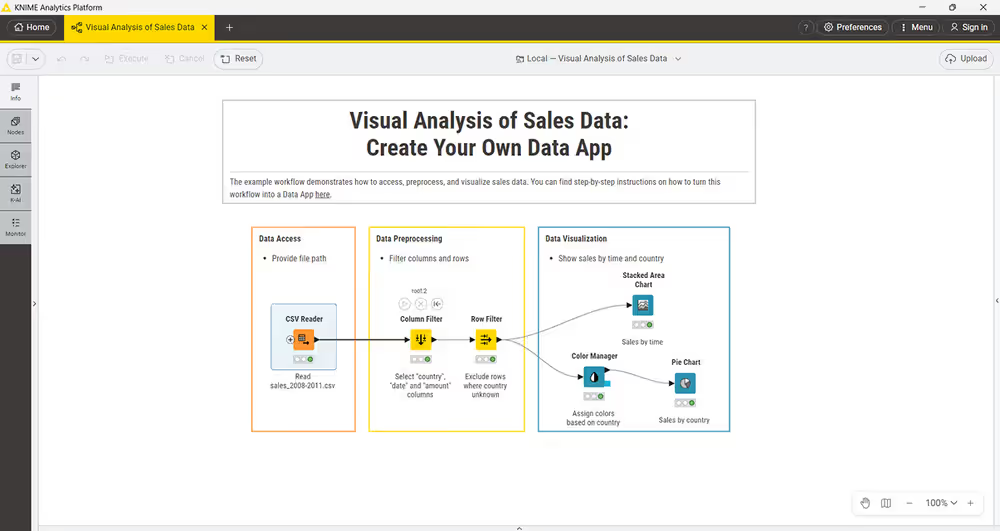
WORKFLOW REALE · PIPELINE DI ANALISI · FONTE: KNIME DOCS
REAL WORKFLOW · ANALYSIS PIPELINE · SOURCE: KNIME DOCS
02 · How to use it well

The things that make the difference.

The model's cycle

The business problemchurn, demand, quality
Features & training
Validation
Deployment (Hub)
build · test · serve
Monitoring & retrainingthe model that stays good
Corporate historical datathe raw material
The forecast as a process, not magic

The right problem

You start where the forecast changes a decision: demand forecasting, churn, scrap — the ROI before the algorithm.

Honest validation

Temporal holdouts and business metrics: the model promoted with the real numbers, not the train score.

Deployment on the Hub

The model as a scheduled service or API: the forecast inside the processes, not in the slides.

The drift watched

The performance monitored over time: the retraining when needed, not never or always.

03 · In depth

From churn to predictive maintenance, as nodes

Machine learning in KNIME is visual but serious: partitioning and cross-validation as nodes, the learners (trees, random forests, XGBoost, networks) with the predictors, the AutoML that tries and compares, the evaluation (ROC, confusion matrix, lift) readable, the interpretability (SHAP, permutation importance) to explain to the business; the deployment is the strong point: the same flow that trains becomes the service that predicts, on the Hub, scheduled or via API.

  • Pipeline completa — prep, training, evaluation, deployment: all in the graph
  • XGBoost & co — the competition-grade algorithms, without writing the boilerplate
  • AutoML — the models compared by themselves: the baseline in an hour
  • SHAP — the why of the prediction: the model that explains itself
  • Train→serve — the same workflow trains and serves: no reimplementation
  • Retraining schedulato — the model that updates itself on the Hub
04 · Numbers and lifecycle

The numbers that matter.

h
the first baseline with AutoML
0
gap between the notebook and production: the flow is already the deployment
SHAP
interpretability as standard
mensile
the typical scheduled retraining
The ML that pays off is the one in production: use cases, models and retraining taken live by us — not slides, services.
05 · Use cases

Where it really pays off.

Demand forecasting

Stock and production guided by the models.

Churn & propensity

The at-risk customers seen earlier.

Predictive quality

The scrap anticipated by the process data.

Useful ML is the one in production: from KNIME to the Hub the journey is short — we accompany it.