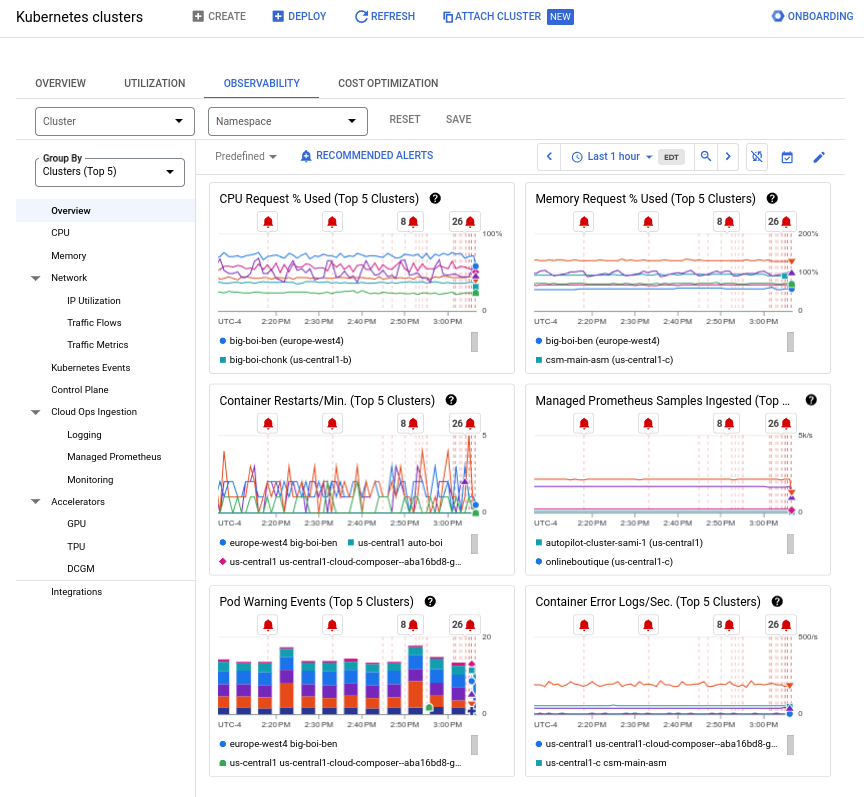
Managed Kubernetes from those who invented it: with Autopilot you delegate the nodes too and pay only for the pods that run.
Google created Kubernetes and GKE remains the reference: release channels updated first, Autopilot removing node management (you declare the pod, Google handles the rest, you pay for what's requested), and true scale — clusters up to 65,000 nodes for the most extreme AI workloads.


For most workloads it's the right choice: less operational surface, costs aligned with use.
On Autopilot you pay the requests: tuning the pods' CPU/memory is directly money.
Multiple clusters governed as a fleet: policies and config from a single place.
Workload Identity, Binary Authorization, GKE Sandbox: the defenses that elsewhere are projects.
GKE offers two modes: Standard (you govern the nodes) and Autopilot (you pay for the pods, Google manages the nodes, hardening included). Release channels (rapid/regular/stable) and maintenance windows govern the automatic upgrades of the control plane and nodes; the cluster autoscaler and node auto-provisioning add the right size on their own; Workload Identity federates the pods on IAM; Backup for GKE protects state and manifests.
The cloud-native runtime with minimal maintenance.
Queues and training on spot, orchestrated by K8s.
Prod, DR and regions under a single fleet.