Red Hat · Infrastruttura · YoctoIT tech page

RHEL

The enterprise Linux standard: ten years of lifecycle, certified hardening and real support — on x86 and IBM Power.

FOCUS · THE LINUX YOU CAN SIGN FORSubscription, security and lifecycle: the Linux a company can promise
YoctoIT material for clients and partners · Red Hat, RHEL, OpenShift, Ansible and the other products mentioned are trademarks of Red Hat, Inc. o di sue affiliate.
01 · What it is

Red Hat Enterprise Linux, made clear.

RHEL is the Linux the enterprise can make promises with: 10 years of support per release, timely security patches, hardware and software certifications (SAP included) and a tooling ecosystem — Insights, Image Builder, System Roles — that makes the estate manageable, not just installable.

10 anni
the lifecycle of every major release: you plan, you don't chase
ppc64le
RHEL runs certified on IBM Power: our favorite combination
Insights
predictive analysis included: CVEs and risky configurations flagged beforehand
Red Hat Enterprise Linux
OFFICIAL RED HAT BRANDING · RHEL
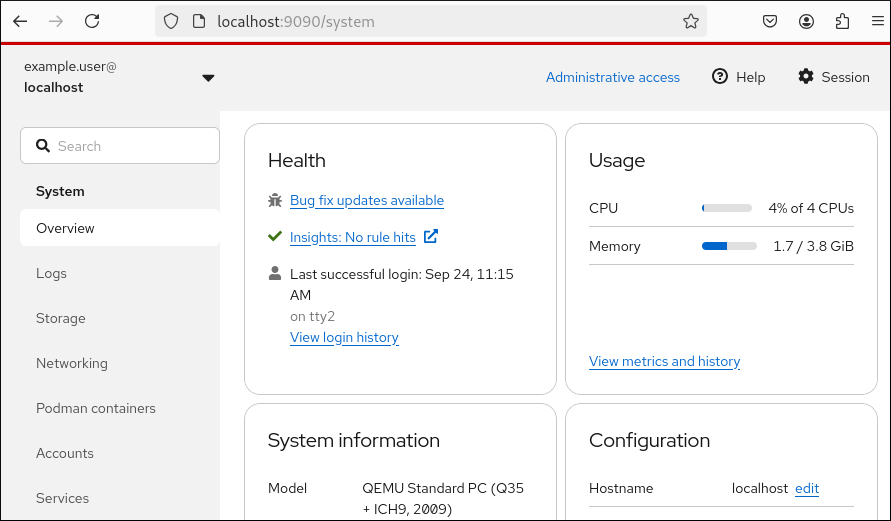
CONSOLE REALE · RHEL WEB CONSOLE (COCKPIT) · FONTE: RED HAT DOCS
REAL CONSOLE · RHEL WEB CONSOLE (COCKPIT) · SOURCE: RED HAT DOCS
02 · How to use it well

The things that make the difference.

The managed lifecycle

Applications & middlewarewhat the business sees
RHEL 8
RHEL 9
RHEL 10
releases in parallel, migrations planned
Satellite & Insightspatching, compliance, drift
x86 · IBM Power · cloudsame OS, everywhere
One standard, all platforms

Estate standardization

A single OS base with golden images, System Roles and security baselines: variance is the enemy of reliability.

Patching without drama

Minor releases and errata in scheduled windows, with Satellite orchestrating: patching becomes routine, not a project.

Certifiable security

SELinux, SCAP/CIS profiles, FIPS: documented hardening that passes NIS2 audits.

Migrations from CentOS/others

Convert2RHEL and methodology: from 'free' Linux to supported Linux without reinstalling.

03 · In depth

Subscriptions, streams and images

RHEL lives by lifecycle: every major has 10 years (5 full + 5 maintenance) with twice-yearly minors and Extended Update Support to stay on a minor for up to 2 years. Application Streams decouple runtimes (Python, Node, DBs) from the OS; Image Builder produces golden images for bare-metal, VMs and cloud; Insights analyzes the fleet and suggests remediations; the web console (Cockpit) administers from the browser, kpatch applies critical kernel fixes without rebooting.

  • 10 anni — of support per major (RHEL 9 until 2032): you plan, you don't chase
  • EUS — Extended Update Support: the minor frozen for 24 months for rigid environments
  • Application Streams — runtimes versioned independently of the OS: Python 3.12 on RHEL 9 without acrobatics
  • Image Builder — blueprint → qcow2/AMI/ISO: the reproducible golden image
  • Insights — CVEs, drift and recommendations from telemetry: included in the subscription
  • kpatch/livepatch — critical kernel fixes without reboots: windows saved
04 · Numbers and lifecycle

The numbers that matter.

10
years of lifecycle per major release
2
minors per year (x.1-x.10): the predictable pace
24
months of EUS for selected minors
3
main architectures: x86_64, ppc64le, aarch64
RHEL 9 is the current base, RHEL 10 the next home: we manage in-place upgrades with Leapp, CIS baselines and patching in waves from our NOC.
05 · Use cases

Where it really pays off.

Base for SAP and databases

The operating system under the workloads that cannot stop.

Consolidation on Power

RHEL on Power LPARs: density and resilience x86 doesn't know.

Regulatory compliance

The Linux estate with patching and hardening evidence for the auditors.

'Free' Linux gets expensive at the first incident: RHEL managed by us is the Linux with SLAs.