Citrix · Infrastruttura · YoctoIT tech page

Provisioning

The golden images distributed to hundreds of workstations: the update in one night, the rollback in one click.

FOCUS · ONE IMAGE, A THOUSAND DESKTOPSMCS and PVS: the patch is installed once — and a thousand desktops wake up updated
YoctoIT material for clients and partners · Citrix, NetScaler, HDX and the other products mentioned are trademarks of Cloud Software Group, Inc.
01 · What it is

Provisioning (MCS & PVS), made clear.

The secret of scale in VDI is the single image: with MCS (clones from the hypervisor) or PVS (streaming the image from the network), hundreds of desktops are born from ONE golden image. The monthly patch is applied there; at reboot, the whole fleet is updated. And if something goes wrong: rollback to the previous version, in one click.

1→N
one golden image, hundreds of identical machines
Rollback
the previous version ready: the update without fear
Non-persistent
the desktop reborn clean at every boot: no sediment
Provisioning (MCS & PVS)
OFFICIAL CITRIX BRANDING · PROVISIONING
CONSOLE REALE · PROVISIONING CONSOLE · FONTE: CITRIX DOCS
REAL CONSOLE · PROVISIONING CONSOLE · SOURCE: CITRIX DOCS
02 · How to use it well

The things that make the difference.

The mechanism

Hundreds of desktops/app serversthe fleet, identical
The golden image
Versions
MCS or PVS
the original · the history · the distribution
Update → reboot → donethe patching in one night
Profiles & data elsewhere (FSLogix)the user survives the reboot
The fleet like prints from one negative

The MCS vs PVS choice

Storage, network and scale decide: we've done the matrix a hundred times, we'll do it on your case.

A disciplined image

A documented, automated build sequence: the golden image reproducible, not artisanal.

Separated profiles

FSLogix for profiles and Office: the non-persistent that feels persistent.

Test ring

The new image on a pilot group before the fleet: the wild night avoided.

03 · In depth

MCS vs PVS: how the desktops are born

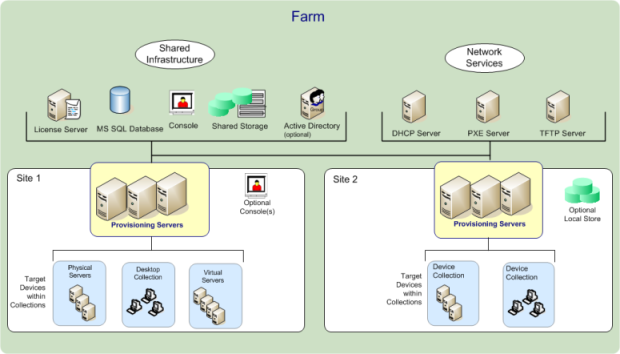
Two provisioning engines: MCS clones from the golden image onto the hypervisors'/clouds' storage (simple, everywhere), PVS streams the image from the network (diskless targets: the write cache in RAM with overflow) and wins in the big physical fleets and the classrooms; the golden image is the heart: one image, a thousand identical desktops, the update is done once and promoted by versions with rollback; App Layering separates OS, platform and apps into composable layers.

  • MCS — clones from the golden image: provisioning without extra infrastructure
  • PVS streaming — the image over the network, the write cache in RAM: the reboots that clean
  • The golden image — one image for a thousand machines: the update once only
  • Versioning — the promotion with rollback: the wrong update gets undone
  • App Layering — OS, apps and user layers separated: the combinations without infinite images
  • Non-persistent — the desktop reborn clean: the malware doesn't survive the reboot
04 · Numbers and lifecycle

The numbers that matter.

1
one image per fleet: the maintenance collapses
1000+
the targets per PVS server pair
RAM
the write cache: the storage IOPS collapses
reboot
the sanitization: the non-persistent restarts clean
The single image is the TCO's lever: golden image, versions and layers managed by us — the fleet that updates in one night.
05 · Use cases

Where it really pays off.

Large fleets

From 100 workstations up, the only sensible way.

Lightning patches

The critical CVE closed on the fleet in 24 hours.

Pulled environments

Classrooms, shifts, call centers: the desktop always clean.

Updating a thousand desktops is a nightmare — or one night: it depends on the image. We make it right.