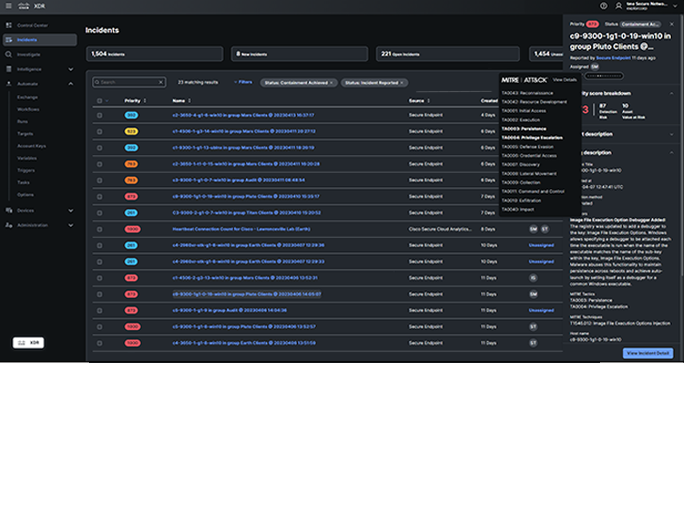
Extended detection and response: the signals from network, endpoints, email and cloud correlated into prioritized incidents — with guided response.
Cisco XDR collects the signals from the whole stack — firewalls, endpoints (Secure Endpoint or third-party EDRs), email, identity, network and cloud — and correlates them into incidents with a MITRE attack chain and risk priority. The response starts guided or automatic: isolate the host, block the hash, revoke the session. The SOC works on stories, not noise.


XDR accepts non-Cisco EDRs and tools: what's already there gets valued.
Who isolates what and when: automation with the rules written together.
The incidents ordered by real impact: the analyst's time where it's needed.
XDR inside the YoctoIT process: tickets, escalations and reports like for everything else.
Cisco XDR ingests endpoints (Secure Endpoint and third-party EDRs), network (NDR, NetFlow), mail, identity and firewalls: the correlation builds incidents with chain of custody, the prioritization weighs assets and impact, the playbook automation responds (isolate host, block hash, disable user), the open integration (CrowdStrike/Defender/SentinelOne too) avoids rip-and-replace; Talos enriches every observable.
The correlation that replaces three analysts you don't have.
The chain seen early, the response in seconds.
Fewer consoles, more answers.